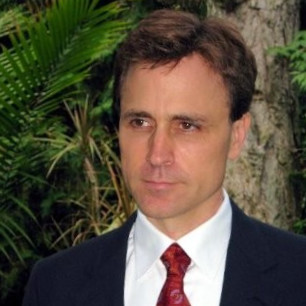
Six books, two decades of clinical work, and the first comprehensive scoring of state AI education policy — all asking the same question: what is technology doing to how people learn?
Kevin J. Roberts, M.A., did his graduate work in neuroscience and went on to collaborate with numerous researchers and clinicians, including psychiatrist Dr. David Rosenberg of Children's Hospital of Michigan on a program featured on ABC's 20/20, examining the mental health and brain differences in screen-addicted youth. He has since presented Grand Rounds at Children's Hospital of Michigan — twice — and has maintained direct clinical affiliations with treatment centers serving compulsive technology users for over two decades.
That clinical foundation is what separates his voice from the crowded field of AI commentators. When Cyber Junkie was published in 2010 — examining what compulsive screen use does to a developing brain — screen addiction was not yet a mainstream public health conversation. His newest book, The Effort Crisis, examines what AI is doing to the act of learning itself: not whether students are cheating, but whether the effort required to build real knowledge is being quietly eliminated.
Of the 36 states that have published AI education guidance, only one asks the question that matters most: what should students still do themselves before turning to AI? One state out of fifty. The Effort Crisis argues this is the central question in education right now — and America's AI Report Card found that 49 states aren't asking it.
I have invited Kevin Roberts to speak at conferences and events across the UK and Europe more than fifty times. That number alone should tell you something. He is one of the very few voices in the field who combines rigorous scientific grounding with the rare gift of making that science feel urgent, personal, and immediately applicable to parents, to clinicians, and to the young people themselves. As the field has shifted toward artificial intelligence and its impact on learning, Kevin has moved with it. And ahead of it. His research into how schools are and are not preparing students for an AI-shaped world is exactly the kind of work the education community needs: independent, data-driven, and deeply human. He is not simply an expert. He is a catalyst. Families across Europe have been transformed by his work. I recommend him without reservation.Andrea Bilbow, OBE Past President, ADHD Europe
Kevin Roberts has spoken and given workshops throughout Scotland on numerous occasions at my invitation. He brings something rare: a deep grounding in the science of neurodivergence and addictive technology, delivered in a way that genuinely moves people. Families leave his sessions not just better informed, but changed. What makes Kevin distinctive is that he doesn't stop at the problem. He brings a powerful, infectious message of hope. Increasingly, he also brings a sophisticated expertise in how technology, including AI, can be used as a tool for growth rather than a source of harm. That shift in framing has had a lasting impact on the young people and families we serve. I recommend Kevin without reservation to any organization that serves neurodivergent young people and their families.Alison Clink CEO, Dundee and Angus ADHD Support Group, serving neurodivergent youth and families across Scotland
Kevin gave an incredible talk at our conference in Athens for ADHD Hellas. He helped many of the participants appreciate the many strengths and gifts that ADHD often brings with it. What made it particularly memorable was that he gave part of the talk in Greek — discussing his compelling case that Alexander the Great may well have had ADHD. The audience was captivated. I would welcome Kevin back to speak for our community without hesitation.Christina Georgiadou President, ADHD Hellas
My organization had Kevin speak to our group in Utrecht, and the response from clinicians, parents, and educators was genuinely strong. His research into Oskar Schindler is well-documented and thoughtfully presented, and I believe it has changed the way many people in our field think about ADHD.Dr. Rob Rodrigues Pereira Pediatrician and Chairman of the Dutch ADHD Network, Rotterdam, Netherlands
My wife and I accompanied Kevin on his ADHD Change the World Tour, a Holocaust-oriented journey built around the life of Oskar Schindler. Seeing young people with ADHD begin to understand that the very traits that had complicated their lives were the same traits that saved 1,200 lives was a meaningful experience. I also had the opportunity to collaborate with Kevin on a scholarly article for the ADHD Europe journal examining Schindler through this lens, and found him to be a rigorous and collegial researcher.
His more recent work on what technology and artificial intelligence are doing to how young people learn is important and timely. As a developmental pediatrician I saw this in my practice. Kevin has been asking these questions seriously and for some time. I recommend him to any organization working at the intersection of neurodevelopment, technology, and education.
Graduate work in neuroscience. Participated in scientific studies examining the cerebral impact of excessive screen use. Has worked directly with video game addicts and maintained affiliations with treatment centers. Presented Grand Rounds at Children's Hospital of Michigan. Twice.
Spoken at conferences and given workshops in ten countries. More than fifty appearances across the UK and Europe at the invitation of leading neurodivergence organizations including ADHD Europe. Speaks seven languages.
America's AI Report Card is the first study to comprehensively score every state AI education guidance document. Its companion report, The Global AI Education Gap, puts U.S. policy in international context: six countries have made AI education mandatory while 14 U.S. states have published no guidance at all.
What happens to learning when we hand students a shortcut before they've built the skills to know when not to use it. The book that America's AI Report Card was built to support.
AI in EducationKevin's memoir of gaming and internet addiction, one of the first books to name and address the problem before it became a public health conversation. Studied in counseling programs nationwide.
Screen AddictionThe essential family guide to healthy screen behavior. A practical roadmap for parents navigating screen time, gaming, and digital habits. Available as a free download at aiedge.live.
Parenting · Screen TimeHow the traits that define ADHD: impulsivity, hyperfocus, unconventional thinking. These traits turned out to be exactly the traits that saved 1,200 lives. Foreword by David Giwerc, founder of ADD Coach Academy.
ADHD · HistoryADHD reframed as a superpower rather than a deficit. The book that positioned Kevin as one of the leading voices on neurodiversity and human potential.
ADHD · LeadershipA memoir about holding 100+ jobs, relentless resilience, and finding your path. The book about what it looks like to keep going when the conventional path doesn't fit.
Memoir · ResilienceHow students should learn to use AI as a genuine thinking tool and not a shortcut. The curriculum question most schools are getting wrong. The difference between AI that builds skills and AI that replaces them. Author of America's AI Report Card (the first comprehensive scoring of state AI education policies) and The Global AI Education Gap (a country-by-country comparison showing where the U.S. stands against China, the UAE, South Korea, India, Singapore, and the EU).
Graduate work in neuroscience. Participant in scientific studies on the cerebral impact of excessive screen use. Direct clinical work with video game addicts and affiliation with treatment centers. Grand Rounds presenter at Children's Hospital of Michigan. Author of two books on this topic before it was mainstream.
Deep expertise in how ADHD students learn, fail, and succeed. Author of three books on ADHD including Schindler's Gift and Movers, Dreamers, and Risk-Takers. International speaker at CHADD, ADDA, ADDISS, and ADHD Europe. More than fifty conference appearances in the UK and Europe alone.
End-to-end college admissions coaching with a track record of student acceptances to Michigan Ross, Yale, UPenn, CU Boulder, and beyond. Packages from targeted 2-session jumpstarts to 3-year partnerships beginning sophomore year.
Workshops and conference presentations in ten countries. Speaks seven languages. Experience adapting complex scientific content for diverse cultural and professional audiences: parents, clinicians, educators, and policymakers.
The AI Edge is the program Kevin built because the one he wanted for students didn't exist yet. Five days. Grades 8–12. Michigan in-person and nationwide virtual. Students leave knowing how to use AI as a study partner, a research tool, and a thinking coach and not a shortcut.
Co-founded with Henry Dan, a former member and coach of the Cambodian Math Olympiad Team, and a data scientist specializing in machine learning. Henry is trilingual in Khmer, English, and Mandarin, and brings technical depth and genuine warmth in equal measure.
Learn More →Kevin is available for media interviews, speaking engagements, podcast appearances, and consulting. For dataset requests from America's AI Report Card or The Global AI Education Gap, reach out directly.
kevin@kevinjroberts.net · 248-867-3591 · kevinjroberts.net